How Negative Ion Air Purifier Ionizers Work?
Negative ion air purifiers use air ionization technology to generate negative ions that interact with airborne particles through charge-based interactions. These particles gradually agglomerate and settle naturally, helping reduce airborne particle concentration. This article explains the three-step working process of ionizer technology and how it differs from traditional HEPA filtration systems.
Negative ion air purifiers operate based on air ionization technology.
The core principle is to electrically charge oxygen molecules in the air, generating negative ions that interact with airborne particles through charge-based interactions.
The process can be explained in three steps:
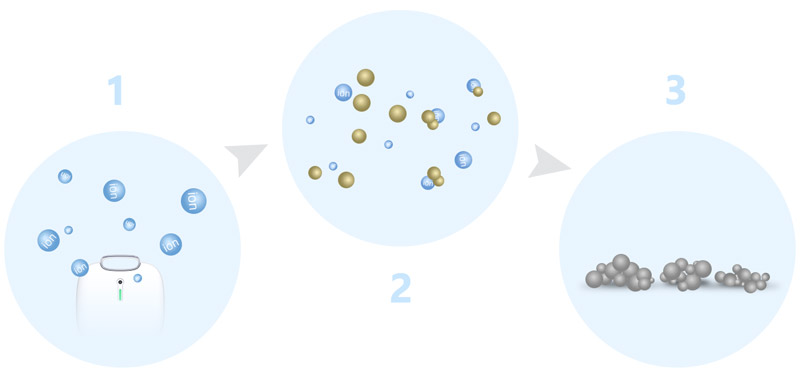
1. Ionizing
An ionizer, also known as a negative ion air purifier, uses high-voltage ionization to charge oxygen molecules in the surrounding air, continuously generating and releasing negative ions.
2. Attraction, Agglomeration & Neutralization
Negative ions interact with airborne particles such as dust, pollen, smoke, and PM2.5.
Through charge interactions, particles are attracted to each other and gradually bind together. During this process, charge neutralization may also occur, leading to the formation of larger particle clusters.
3. Settling
As particle clusters grow in size, they become heavier and gradually settle out of the air onto surrounding surfaces.
This process helps reduce the number of particles remaining suspended in the air and decreases the likelihood of them re-entering the breathing zone.
Ionization vs Traditional Filtration
Traditional HEPA filtration systems rely on mechanical filters and airflow to physically capture airborne particles.
In contrast, negative ion technology influences airborne particles through charge-based interactions, promoting particle agglomeration and natural settling.
Some of our air purifier models combine multiple technologies, including: HEPA filtration, activated carbon filtration, negative ion ionization to provide a multi-layer air treatment approach.
Key Advantages of Negative Ion Technology
Compared with traditional filter-based air purification systems, negative ion technology offers several advantages:
No frequent filter replacement required
Negative ion systems do not rely on consumable filter media that require regular replacement.
Low-maintenance operation
Under normal usage conditions, only basic cleaning and routine device maintenance are required.
Continuous operation
Negative ions can be continuously generated to support ongoing air treatment.
Compact and flexible design
The technology can be easily integrated into compact devices such as vehicle air purifiers, desktop units, and portable air systems.
Conclusion
Negative ion air purifiers work by generating negative ions through air ionization, which interact with airborne particles via charge-based interactions. These particles gradually agglomerate and settle naturally, helping reduce airborne particle concentration.
Thanks to their compact structure, continuous operation, and low-maintenance design, negative ion technologies are widely used in vehicle air products, desktop air devices, and personal air systems.